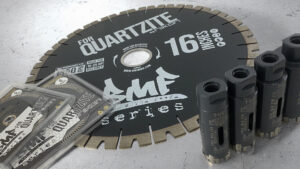







Engineered stone (commonly called quartz) is composed of crushed stone, resins, and pigments, making it denser and more uniform than natural stone—but also heat-sensitive and prone to burn marks or resin discoloration if the wrong tools or settings are used.
Learn the difference between Quartz and Quartzite.
Burning or discoloration due to heat buildup from friction.
Segment glazing on hard resins.
Chipping along edges if tool aggressiveness is mismatched.
Dust management, especially when cutting dry.
Primary: Stinger BLACK™ V2
Patterned 25mm segments provide clean, chip-free cuts and long life with less vibration.
Alternative: Spider™ II Blade
Ideal for shops looking for speed and affordability with clean finish.
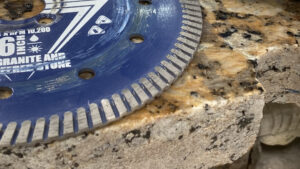
Primary: Stinger Black Turbo Blade
Resin-safe and designed for dense, smooth quartz cutting.
Alternative: Spider™ Turbo Blade
Great general-purpose blade for quartz fieldwork.
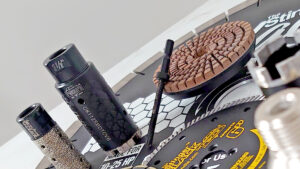
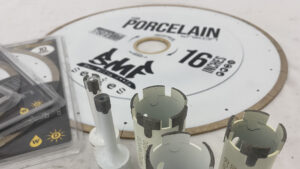
Primary: Stinger T-TYPE Core Bit
Excellent for resin-based slabs—prevents cracking or discoloration from heat.
Alternative: Spider™ Vacuum-Brazed Core Bit
Great for installers or tight access areas where wet drilling isn’t an option.
Primary: Stinger ES 3-Step and 7-Step Pads
Polishes quartz quickly and cleanly without resin haze.
Alternative: Spider™ ES 3-Step Pads
High-Quality finish at an affordable price.
✅ Avoid dry cutting whenever possible—heat is the enemy of quartz.
✅ Reduce RPMs and use slower feed speeds to prevent burn marks.
✅ Use resin-safe blades with proper segment bond to avoid glaze.
✅ Keep all tools sharp and cool during fabrication.
“If you’re seeing white or yellow haze near your cut edge, that’s resin burn. Back off the feed speed, increase water, and ensure proper blade bond.”