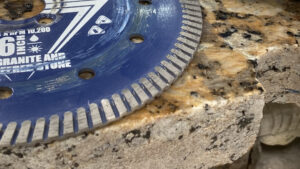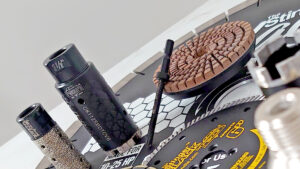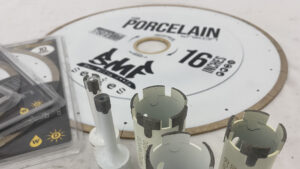







Porcelain slabs and sintered stones like Dekton, Lapitec, and Neolith are ultra-compact surfaces created by combining raw materials under intense heat and pressure. These materials are incredibly hard, dense, and brittle, making them highly prone to chipping, cracking, or blowout during fabrication.
Learn more about Porcelain and other Ultracompact Materials.
Chipping and blowouts due to extreme surface tension and hardness.
Blade deflection if improper tooling or technique is used.
Fast glazing or dulling of standard diamond segments.
Minimal room for error – edge finish must be perfect.
Porcelain: BMF™ Porcelain Bridge Saw Blade
Ultra-thin silent core with fine-grit segment for micro-chip reduction.
Specifically engineered for porcelain and sintered stone.
Dekton: BMF™ Dekton Bridge Saw Blade
Designed for the hardest Ultra-compact materials.
Primary: BMF™ Porcelain Continuous Rim Blade
Thin-kerf and high-concentration diamond pattern designed for field cuts with angle grinders.
Alternative: BMF™ All Cut Pro Blade
High-quality dry cutting option for the cleanest cut.
Primary: BMF™ Thin-Wall Core Bit
Thin kerf with soft bond and sharp diamonds for chip-free drilling.
Alternative: BMF™ Porcelain Non-coring Bit
Great for handheld or field use where water supply may be limited.
Primary: Stinger™ 7-Step Wet Polishing Pads
High precision polish with minimal pressure.
Alternative: Stinger™ Hybrid 3-Step Pads
Versatile pads that work wet or dry with excellent results on Dekton and sintered materials.
✅ Use slow feed rates and light pressure — let the tool do the work.
✅ Always cut wet with porcelain and sintered stone; dry cutting increases chip risk and shortens tool life.
✅ Use high-quality silent core blades to reduce deflection and vibration.
✅ Reduce RPMs slightly and keep water flow constant and even.
✅ Drill slowly and avoid forcing core bits; small start holes can help reduce blowouts.
“If you hear a high-pitched squeal while cutting, your blade is glazing — stop and dress the blade before continuing.”